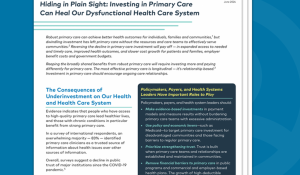
"Stabilizing health spending and targeting it in ways that ensure access to care and improve health outcomes would free up billions of dollars annually for critically needed economic and social investments."
More than 3.5 billion prescriptions are written annually in the United States, and four out of five patients who visit a physician leave with at least one prescription. Medications are involved in 80 percent of all treatments and impact every aspect of a patient’s life.
The Nursing Alliance for Quality Care (NAQC) released Guiding Principles for Patient Engagement, a list of nine core principles designed to support nurses and other health care providers in delivering high-quality, patient-centered care. The principles, developed by a committee of nurse leaders and patient advocates, are meant to guide the provider community in developing patient engagement models and quality and safety interventions that support and encourage the patient and family to become partners in their care.
The patient-centered medical home model has been proposed by the major primary care professional societies as a way to achieve more effective, less costly care. Commonwealth Fund–supported researchers reviewed the professional literature and convened a panel of experts to identify characteristics of fully transformed medical homes and the necessary changes to infrastructure, organization, and care delivery that practices and clinicians must make to get there.
To become patient-centered medical homes, primary care practices must:
Despite years of discussion and research, formalized care coordination is a relatively new concept for primary care practices. Measurement criteria for care coordination are emerging, but we are still watching the earliest stages of its evolution. It will be some time before the elements for success in care coordination are quantified on a broad scale, but the foundation has been laid for pilots and early adopters to educate and inform the greater primary care community in the years to come.
<p>Patients, families, and caregivers can often find the concept of medical home confusing or hard to understand. This brochure can be used by providers and members of the medical home team to understand the value of high-quality, patient-centered care, and the potential for improving their health care experience. Patients have reported better coordinated care, easier navigation of the health care system, and overall better experiences in a medical home model of care. This educational brochure is provided in English and Spanish and is available to share.</p>
The care of individuals with diabetes—in particular, those with diabetes mellitus (type 2 diabetes)—provides one of the best opportunities to illustrate the promise of the patient centered medical home. The medical home offers patients a team-based model of care led by a provider that ensures high-quality, compassionate and coordinated care, superb access and communication, and is committed to quality and safety. A number of demonstrations and pilot programs across the nation have shown that, properly deployed, the medical home model can improve outcomes and lower costs.
The idea of the patient-centered medical home as a possible solution to the problems that arise from poor-quality, fragmented, expensive health care has attracted interest from a wide range of stakeholders. The principles that characterize the patient-centered medical home describe the responsibilities and attributes professionals and institutions that must be met in order to qualify as a legitimate medical home (Patient-Centered Primary Care Collaborative, 2008).
Most employer know that a mentally healthy work-force is linked to lower medical costs, as well as less absenteeism and presenteeism. And more employers know that a mentally unhealthy workforce is associated with increased loss of productivity. What employers may not know, however, is how to get from A to B: How does a company change a mentally unhealthy workplace - or a marginally health one - to a health workplace?